
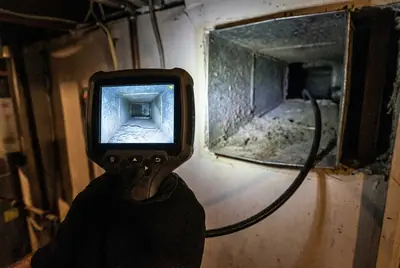
Duct camera inspections
A recorded pass through supply and return trunks, with findings you can watch rather than take on faith.
Everywhere in Barnstable County, duct runs and air handlers come back clean, resealed and photographed, on hours the buildings choose.
Free, technical, and it ends in a written price that does not drift.
Dust, pollen and nasty debris pass through the big metal tubes of a building in Barnstable County, MA each time the heating or cooling equipment runs. Those tubes sit inside the ceiling grid and collect buildup over time. Local professionals clean the air pathways and inspect the system for dirty air passages.
First off, let us talk about all that nasty buildup sitting inside your building right now. Every single day, your heating and cooling equipment blows tons of hidden dust, pollen, and nasty debris right through those big metal tubes hidden inside your ceiling grid. On top of that, dirty air pathways force your heavy fans to push extra hard just to move a tiny bit of fresh air into your workplace. Naturally, that extra strain makes your monthly electric bill shoot straight through the roof during heavy winter or summer seasons.
Which means you are basically throwing away hard-earned money just to breathe in old, moldy grime with your crew. Surprisingly, a huge layer of gray fuzz was clogging up the whole system and burning out the blower motor. Afterwards, calling in a crew to scrub out the main trunk lines completely saved my sanity and lowered my utility costs big time.
Furthermore, keeping your workspace neat isn't just about looks, it keeps everyone feeling good while they work. In fact, clean blowers help stop employee sick days by removing hidden allergens before they spread around offices. Additionally, your customers will notice right away when your lobby smells super fresh instead of smelling like an old damp basement.
To begin with, ignoring your overhead air passages creates a massive fire risk that many building owners totally forget about. Over time, light dust and tiny grease bits stick together inside the exhaust channels, waiting for a single heat spark to ignite. Consequently, a small simple vent clean keeps your commercial property safe while protecting your expensive business gear from sudden fire damage.
Therefore, setting up a regular clean keeps your local inspector super happy during those surprise yearly safety visits. Besides, who actually wants to pay a huge fine just because some hidden metal tube was full of dusty gray junk? Moreover, clean blowers let your expensive air conditioning compressors run smooth for years longer without dropping dead early on you.
Now, let us take a quick peek at how a neglected setup wrecks your bottom line compared to a freshly serviced system:
| System Condition | Monthly Energy Impact | Equipment Lifespan | Indoor Air Quality |
|---|---|---|---|
| Dirty and Clogged | Up to 30% Higher Costs | Breaks Down Early | Full of Allergens |
| Professionally Scrubbed | Lowest Utility Usage | Runs Great for Years | Fresh and Breathable |
Clearly, taking care of those overhead channels pays for itself pretty quick when you look at the total monthly savings. Naturally, spending a little bit on maintenance now prevents thousands of dollars in sudden middle-of-the-night emergency repair calls later.
First off, the work crew rolls up to your commercial site with giant rotary vacuum rigs and cool flexible scrub whips. Next, they seal off all your vent openings so no stray dust sneaks into your pristine customer retail rooms. Soon after, high-powered negative pressure machine lines pull every speck of dirty debris out to their main rig truck parked outside.
Because of this heavy power, deep grime stuck inside the tiny metal corners gets loosened up and sucked out completely. So, you get zero leftover mess inside your store while the team cleans out every single branch line overhead. Honestly, watching those clear plastic collector tubes fill up with pounds of gray gunk is super satisfying to watch in person...
Eventually, the crew sprays a safe sanitizing mist inside the whole metal setup to kill off microscopic mold spores. Afterwards, they carefully reinstall all your register grates, making sure every fixture shines like brand new money again. Plus, they double check all fan balance wheels to ensure your whole heating setup hums nice and quiet all day.
Specifically, properties across this famous sandy peninsula suffer from high coastal humidity that makes indoor dust turn into heavy thick mud inside ceiling pipes. Whether your enterprise is located near the busy retail hubs around the local airport roundabouts or down toward the historic shorelines, damp ocean air constantly pushes sand and moisture into your return registers. Indeed, this unique geographic area features over 228,000 year-round residents who all expect clean, safe shop environments whenever they go out spending money.
To put it another way, running a business in the main local county with median household income near $82,000 means high standards for clean air from discerning customers. Even if your building sits in local ZIP code areas like 02601 or 02632, marine atmosphere accelerates interior corrosion if dust is left to rot inside trunk lines. So, taking care of your indoor climate system protects your property value against this harsh salty Atlantic coastal air.
Therefore, hiring a local service crew means getting folks who actually understand these exact local damp weather challenges inside out. Because local techs live right here, they arrive on time without getting stuck in crazy summer bridge traffic jams.
Right now, you can take a fast walk around your shop floor and check out your ceiling air registers closely. Do you see dark black dust rings forming around the white acoustic ceiling tiles near the metal vent frames? If yes, that means your main blowers are actively blowing dirty filth directly into your daily workspace air right now.
Another big red flag is when different office rooms start feeling super hot or icy cold for no real obvious reason. Usually, that spotty temperature issue happens because thick dust drifts block the interior damper fins inside your branch lines. As a result, certain rooms get zero airflow while your main unit works overtime trying to force air through clogged metal passages.
On top of that, funky stale smells whenever your heat turns on in autumn mean mold is growing inside your drain pans. So, if your staff starts complaining about bad smells or itchy eyes, do not wait around for things to get worse!
Initially, you might think servicing those long metal ceiling channels sounds like an expensive project you do not really need right now. However, running dirty air equipment burns through way more extra electricity every single month than a routine service visit costs you. In addition, clean coil fins allow heat exchangers to transfer warmth instantly, cutting down furnace burn cycles significantly.
Which means your business saves money week after week while enjoying optimal indoor cozy atmosphere during freezing winter cold snaps. Furthermore, clean blowers help sensitive electronics and computer servers stay cool so they do not overheat and crash your business database.
Besides, your insurance company might even offer better property coverage rates when you show proof of regular exhaust channel cleaning!
Now, getting your entire building inspected by experienced local technicians does not cost you a single dime to start off. First, a friendly field tech comes out to your location to measure your total pipe runs and inspect your blowers. Next, they show you actual camera photos of what is hiding inside your metal trunks so you see the exact problem yourself.
Then, they hand you a clear, simple written plan showing the exact work needed without any weird hidden surprise fees attached. Consequently, you stay in complete control of your maintenance budget while deciding what service fits your current business schedule best.
So, why keep letting dirty, dusty air drag down your business operations when getting help is so totally easy and fast? Reach out to your local ventilation cleaning team right now to book your fast free estimate and breathe easy today!
A camera goes into the trunk lines first. What comes back decides everything: which runs carry real buildup, which only need their registers washed, and which are clean enough to leave alone. The findings are shown to you, not summarized at you, and if the honest answer is that your ducts do not need cleaning yet, that is what the visit concludes.
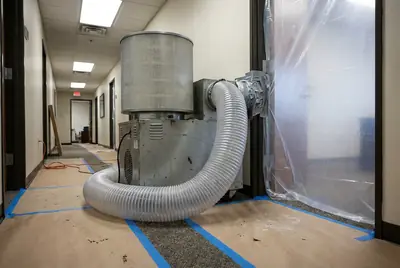
Before anything is loosened, the section under work is isolated and a vacuum collector is coupled to the duct so air moves toward the machine and nowhere else. Floors get covered, ceiling tiles get numbered, and the occupied side of the building keeps working with no idea we are there.
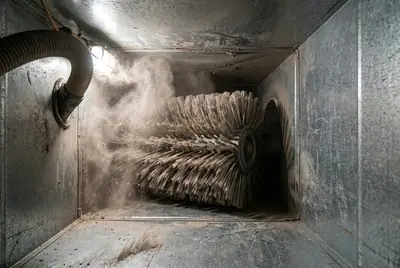
Rotary brushes and compressed air tools work down each run toward the collector, taking the buildup off the metal rather than pushing it deeper. The camera goes back in afterwards. If a stretch still shows residue, it gets done again before the access points are sealed and the registers go back on.
Some buildings need one misbehaving system dealt with. Others need the whole air side reset to zero. The table is the honest version of that choice.
Large sites are phased so no floor loses more than one night, and the same crew lead stays on the job from the first shift to the last photo.
A recorded pass through supply and return trunks, with findings you can watch rather than take on faith.
Rotary brushes and air whips sized to each duct, working the full length of every run toward the collector.
Vacuum units with fine filtration pull everything loosened straight out of the ductwork and off site.
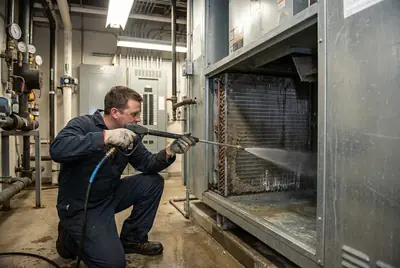
Blower wheels, plenum interiors and coils degreased and rinsed where the air actually picks up its speed.
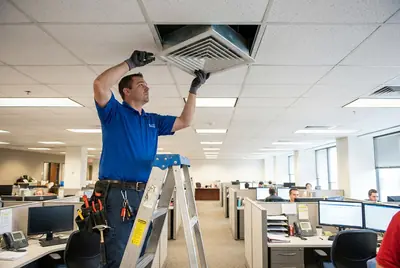
Every visible fitting comes off, gets washed and goes back straight, because occupants judge the job by what they can see.
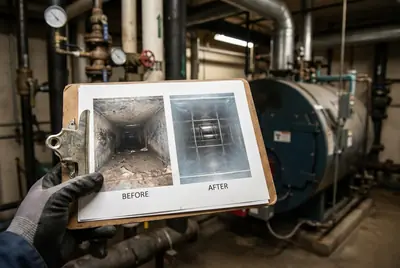
Before and after shots of each run and unit, labeled by floor, sent to whoever answers for the building.
It starts small. Gray fuzz on the desks two days after the janitorial pass. A smell like hot cardboard the first cold morning the heat comes on. A meeting room that feels used up twenty minutes into the hour. The person who sits under the same diffuser and swears the sniffles start on Monday and stop on Friday evening.
None of that proves the ductwork is dirty, and that is precisely why the camera goes in before any quote goes out. But when a building collects complaints of that shape, the supply and return runs are the one place nobody has looked, because nobody can without opening them. Years of drywall sanding, carpet fibers, kitchen aerosols and plain sediment ride the airstream and settle where the air slows down, and every startup of the fans stirs a little of it back over the people below.
After a proper cleaning, the change is undramatic and steady: filters load slower, the startup smell is gone, the dust cycle on the furniture stretches from days to weeks, and the complaints log goes quiet on the subject. Clean air does not announce itself. It just stops reminding people of the alternative.
Our estimator walks the building with whoever knows it best, counts units and registers, lifts a few access panels and listens to what the occupants have been saying.
One document with the scope floor by floor, the night or weekend windows the work will use, and a figure that does not move once you sign it.
Drop cloths down, furniture sheeted where we pass, the first section isolated and coupled to the collector before a single fitting is opened.
Runs brushed to the collector, units and coils cleaned in place, each zone closed and its registers refitted before the crew moves on.
Access points sealed and labeled, the before and after file sent over, and a short note on anything worth budgeting for the years ahead.
Ceiling height, access hatches and how many years the system went untouched decide where inside these spans a building lands. The walkthrough turns them into one firm figure, and the walkthrough is free.
Containment is not a premium option. The section being cleaned is sealed and kept under suction toward the collector for as long as a tool is inside it, the collectors filter what they capture instead of relocating it, and the debris leaves in closed containers the same night. If a ceiling tile moved, it goes back. If a desk was sheeted, the sheet comes off and the desk looks exactly as its owner left it.
Proof beats promises. The camera footage from the inspection, the before and after photos of every run and the list of access points we cut and sealed all go to you, unedited. And when a run turns out not to need cleaning, the quote says so in writing, because a company that cleans ducts for a living should be the one telling you when yours are fine.
Almost never. The work is phased zone by zone during the hours you hand us, usually nights and weekends, and each zone is finished, resealed and back in service before occupants return. Most tenants learn the ducts were cleaned from the memo, not from anything they saw.
By never letting it into them. The section under work is isolated and held under suction toward the collector, so loosened debris travels into the machine and not into the room. Floors and furniture along the route are covered anyway, because equipment gets carried through and belt and braces is the right dress code indoors.
With a camera, before any price is written. Buildup on the duct wall is either there or it is not, and you see the footage yourself. When an inspection finds runs that are still serviceable, the quote says so and shrinks accordingly.
Yes, and we would rather not skip them. The unit is where the air picks up speed, moisture and heat, so a spotless duct behind a dirty blower wheel is a job half done. Interiors, wheels, drain pans and coils are cleaned in place as part of a full building scope.
The dining room, the restrooms and the comfort systems are all standard scope. The grease exhaust over the cooking line is a different trade with different tooling, so it is priced separately at the walkthrough once we have seen the hood and the riser, and we tell you plainly if it needs a specialist instead.
A photo file with before and after shots of every run and unit, labeled by floor, plus the inspection footage and a note on the access points we added and sealed. It is the file you show an owner, an insurer or the tenant who asked, without needing us in the room.
Zoom for the lay of the land; the link lists further down name every community we book walkthroughs in from here.
Somewhere above these ceilings there is ductwork nobody has seen in years.
Book the walkthrough