
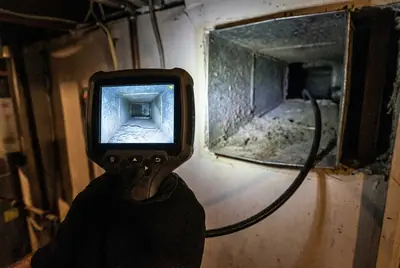
Duct camera inspections
A recorded pass through supply and return trunks, with findings you can watch rather than take on faith.
Offices, storefronts, clinics and classrooms in Macy and the rest of Thurston County get their ductwork inspected on camera, cleaned overnight and documented with photos.
Free, technical, and it ends in a written price that does not drift.
You probably wonder why your office feels stuffy or why sneezing fits happen whenever the heater kicks on. Dealing with clogged ventilation networks in Macy, Nebraska is often the hidden culprit behind poor indoor quality. Getting these massive metal pathways scrubbed out is the best way to ensure your staff stays happy and productive.
Because you manage a business in Thurston County, you know that keeping your overhead low matters. When you prioritize clean air systems, you reduce energy waste and save a lot of cash every single month. This simple step ensures that your building remains a place of total ease for everyone walking through your front doors.
Hidden inside your ceilings and walls, those wide metal channels collect dust and debris over many years. Once these layers build up, your climate control units have to work twice as hard to push air through. This extra stress forces your machinery to consume more power while failing to provide any real climate control benefits.
Instead of paying high utility bills, you should consider having a professional team inspect your internal air distribution paths. When you remove years of grime, the airflow improves instantly, which means your heating and cooling hardware lasts much longer. This saves you from expensive emergency repairs that nobody actually wants to deal with during a busy work week.
You might think that a little bit of dust never hurt anyone, but that is rarely the case in a crowded commercial environment. When particles circulate through your workplace, they settle on surfaces and inside sensitive electronic equipment. This constant layer of dirt makes your office look untidy and forces your cleaning crew to work much harder every single night.
Furthermore, blocked registers and return vents create uneven temperature zones throughout your property. You might notice that some rooms stay freezing while others turn into saunas, which makes staying focused impossible for your employees. Fixing these airflow bottlenecks restores a state of total serenity to your daily operations.
When a crew arrives at your location near ZIP code 68039, they bring industrial-grade vacuums and specialized scrubbing tools to clear everything out. They systematically open access panels to reach deep inside the labyrinthine paths that span your entire structure. By using high-pressure agitation, they loosen caked-on buildup that has been sitting there since the building was first finished.
Once the debris gets sucked into the containment system, your air starts moving freely through the pipes again. This method is incredibly effective for older properties where maintenance has been ignored for a long time. You get to see the actual results of the work, which provides peace of mind that your investment was worth every penny.
| Process Phase | What Happens | Main Benefit |
|---|---|---|
| Assessment | Camera inspection of internal paths | Clear view of hidden contamination |
| Agitation | Mechanical brushing of walls | Total removal of stubborn layers |
| Extraction | High-suction debris removal | Clean air flow throughout zones |
With a median household income around $22,321, we all understand the importance of making smart financial choices for our local enterprises. You do not have to break the bank to get professional help for your facility. By reaching out for a free estimate, you get a clear picture of the project scope without any hidden fees or surprises.
Comparing different options helps you find a service that fits your specific needs perfectly. You deserve a partner who respects your time and delivers results without making a mess of your workspace. Taking action today allows you to plan your budget effectively while keeping your environment safe and pleasant for everyone involved.
You should watch for warning signs like increased allergies among staff or visible dirt collecting around vent covers. Another sign is a musty or stale smell that never seems to go away regardless of how much you clean your carpets. These are telltale indicators that your internal network needs professional attention to restore proper functionality.
Sometimes you might even notice strange noises coming from the ceiling when the furnace or cooler engages. This often happens because loose debris is rattling around inside the metal channels as air passes through at high speeds. Addressing these noises early on prevents potential blockages that could stall your entire climate control system during extreme weather shifts.
Serving a population of 954 people means that your business serves as a vital anchor for our local economy here in this part of the state. You rely on your building to keep operations running smooth, and your infrastructure requires consistent care to prevent minor issues from becoming major problems. Regular maintenance is essentially an insurance policy for your daily productivity levels.
By keeping your air pathways clear, you avoid the risks of fire hazards caused by combustible dust build-up. This is an essential safety feature for any commercial property owner concerned about liability and long-term asset protection. You can sleep better at night knowing that your facility meets the highest standards for internal circulation and safety.
When customers visit your place of business, they notice the subtle details that make a professional impression. A building with fresh, clean air feels inviting and shows that you take pride in every aspect of your operation. This sense of harmony contributes to a positive customer experience that keeps people coming back again and again.
Beyond the physical benefits, improving your indoor environment boosts the morale of your entire team. People enjoy working in spaces that feel crisp and managed rather than dusty and neglected. When you invest in this kind of specialized care, you send a clear message that you value the health of everyone who enters your building.
You might be wondering how to get started on this project without disrupting your normal business hours. Most professional crews can work around your schedule, including early mornings or weekends, to ensure zero downtime for your team. You just need to reach out to get the conversation started and learn exactly how your specific facility can be improved.
Requesting a free estimate is the most logical path to take if you want to understand the potential costs and benefits. You have nothing to lose by asking questions and seeing what a professional thinks about your current setup. This is your chance to transform your work environment into a more efficient, clean, and welcoming space for your local community.
You should view this type of service as a long-term investment rather than a one-time expense. Consistent check-ups on your infrastructure mean you avoid the massive costs of replacing entire ventilation systems later on. Proper care extends the life of your expensive equipment and keeps your operating costs manageable for years to come.
When you choose to keep your pathways clean, you are making a commitment to excellence that reflects well on your business reputation. People in our region appreciate companies that handle their maintenance with care and attention to detail. This proactive approach sets you apart from competitors who choose to ignore these critical infrastructure needs.
Putting off this task only makes the accumulation of debris worse, which complicates the cleaning process later. You do not want to wait until your air quality becomes a significant complaint from your employees or visitors. Tackling the issue now ensures that your facility continues to function as it should, without any unexpected interruptions to your day.
Your business deserves to thrive in an environment that is clean, efficient, and welcoming to all. Do not let hidden buildup compromise your success or waste your hard-earned money on inefficient energy use. Take control of your building's health today by reaching out for your free estimate and seeing the immediate difference for yourself.
A camera goes into the trunk lines first. What comes back decides everything: which runs carry real buildup, which only need their registers washed, and which are clean enough to leave alone. The findings are shown to you, not summarized at you, and if the honest answer is that your ducts do not need cleaning yet, that is what the visit concludes.
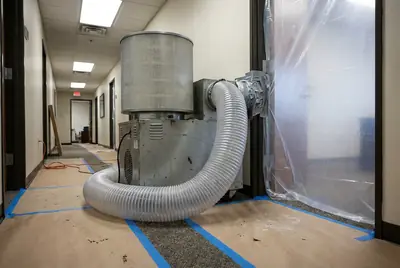
Before anything is loosened, the section under work is isolated and a vacuum collector is coupled to the duct so air moves toward the machine and nowhere else. Floors get covered, ceiling tiles get numbered, and the occupied side of the building keeps working with no idea we are there.
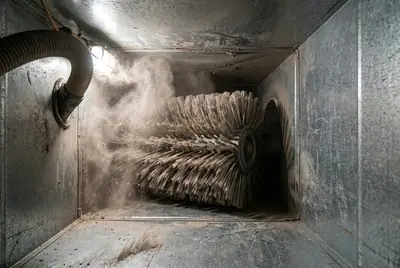
Rotary brushes and compressed air tools work down each run toward the collector, taking the buildup off the metal rather than pushing it deeper. The camera goes back in afterwards. If a stretch still shows residue, it gets done again before the access points are sealed and the registers go back on.
Some buildings need one misbehaving system dealt with. Others need the whole air side reset to zero. The table is the honest version of that choice.
Large sites are phased so no floor loses more than one night, and the same crew lead stays on the job from the first shift to the last photo.
A recorded pass through supply and return trunks, with findings you can watch rather than take on faith.
Rotary brushes and air whips sized to each duct, working the full length of every run toward the collector.
Vacuum units with fine filtration pull everything loosened straight out of the ductwork and off site.
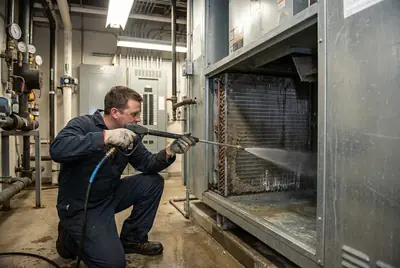
Blower wheels, plenum interiors and coils degreased and rinsed where the air actually picks up its speed.
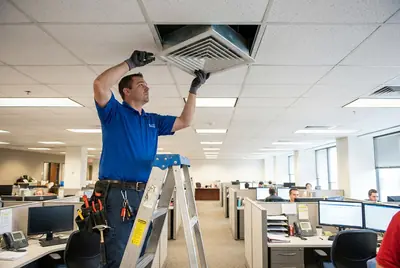
Every visible fitting comes off, gets washed and goes back straight, because occupants judge the job by what they can see.
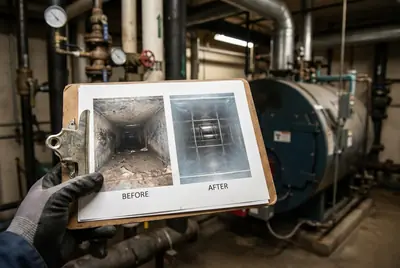
Before and after shots of each run and unit, labeled by floor, sent to whoever answers for the building.
It starts small. Gray fuzz on the desks two days after the janitorial pass. A smell like hot cardboard the first cold morning the heat comes on. A meeting room that feels used up twenty minutes into the hour. The person who sits under the same diffuser and swears the sniffles start on Monday and stop on Friday evening.
None of that proves the ductwork is dirty, and that is precisely why the camera goes in before any quote goes out. But when a building collects complaints of that shape, the supply and return runs are the one place nobody has looked, because nobody can without opening them. Years of drywall sanding, carpet fibers, kitchen aerosols and plain sediment ride the airstream and settle where the air slows down, and every startup of the fans stirs a little of it back over the people below.
After a proper cleaning, the change is undramatic and steady: filters load slower, the startup smell is gone, the dust cycle on the furniture stretches from days to weeks, and the complaints log goes quiet on the subject. Clean air does not announce itself. It just stops reminding people of the alternative.
Our estimator walks the building in Macy with whoever knows it best, counts units and registers, lifts a few access panels and listens to what the occupants have been saying.
One document with the scope floor by floor, the night or weekend windows the work will use, and a figure that does not move once you sign it.
Drop cloths down, furniture sheeted where we pass, the first section isolated and coupled to the collector before a single fitting is opened.
Runs brushed to the collector, units and coils cleaned in place, each zone closed and its registers refitted before the crew moves on.
Access points sealed and labeled, the before and after file sent over, and a short note on anything worth budgeting for the years ahead.
Ceiling height, access hatches and how many years the system went untouched decide where inside these spans a building lands. The walkthrough turns them into one firm figure, and the walkthrough is free.
Containment is not a premium option. The section being cleaned is sealed and kept under suction toward the collector for as long as a tool is inside it, the collectors filter what they capture instead of relocating it, and the debris leaves in closed containers the same night. If a ceiling tile moved, it goes back. If a desk was sheeted, the sheet comes off and the desk looks exactly as its owner left it.
Proof beats promises. The camera footage from the inspection, the before and after photos of every run and the list of access points we cut and sealed all go to you, unedited. And when a run turns out not to need cleaning, the quote says so in writing, because a company that cleans ducts for a living should be the one telling you when yours are fine.
Almost never. The work is phased zone by zone during the hours you hand us, usually nights and weekends around Macy, and each zone is finished, resealed and back in service before occupants return. Most tenants learn the ducts were cleaned from the memo, not from anything they saw.
By never letting it into them. The section under work is isolated and held under suction toward the collector, so loosened debris travels into the machine and not into the room. Floors and furniture along the route are covered anyway, because equipment gets carried through and belt and braces is the right dress code indoors.
With a camera, before any price is written. Buildup on the duct wall is either there or it is not, and you see the footage yourself. When an inspection finds runs that are still serviceable, the quote says so and shrinks accordingly.
Yes, and we would rather not skip them. The unit is where the air picks up speed, moisture and heat, so a spotless duct behind a dirty blower wheel is a job half done. Interiors, wheels, drain pans and coils are cleaned in place as part of a full building scope.
The dining room, the restrooms and the comfort systems are all standard scope. The grease exhaust over the cooking line is a different trade with different tooling, so it is priced separately at the walkthrough once we have seen the hood and the riser, and we tell you plainly if it needs a specialist instead.
A photo file with before and after shots of every run and unit, labeled by floor, plus the inspection footage and a note on the access points we added and sealed. It is the file you show an owner, an insurer or the tenant who asked, without needing us in the room.
Zoom for the lay of the land; the link lists further down name every community we book walkthroughs in from here.
Somewhere above these ceilings there is ductwork nobody has seen in years.
Book the walkthrough