
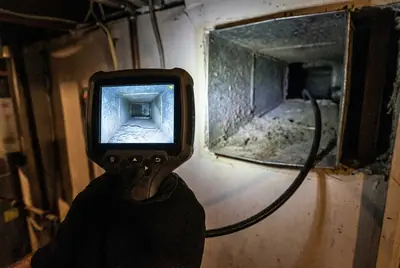
Duct camera inspections
A recorded pass through supply and return trunks, with findings you can watch rather than take on faith.
Offices, storefronts, clinics and classrooms in Morris and the rest of Otsego County get their ductwork inspected on camera, cleaned overnight and documented with photos.
Free, technical, and it ends in a written price that does not drift.
You want to make sure the air inside your building stays fresh for everyone who walks through your doors. This is why you need to look at those hidden metal passages snaking through the ceilings of your business in Morris, New York.
Keeping these internal arteries clear ensures your staff stays productive and happy during the long work days. Ignoring these systems for too long usually leads to a nasty buildup of dust, mold, and other gross stuff that you definitely do not want circulating.
Think about how much stuff accumulates in your own house over a year of living there. Now multiply that by the size of your commercial space in Otsego County and you start to see the problem. Those hidden pathways act like big magnets for debris, and eventually, the air gets thick and dusty.
Getting rid of that gunk allows your equipment to breathe much easier than before. This lets you save money on those crazy power bills because your units do not have to work twice as hard to push air through a clogged pipe. It is honestly just common sense to keep everything running smoothly.
You might not notice the slow decline in quality until someone starts sneezing or the office smells just a bit funky. That is your cue to reach out for a professional evaluation and get a free estimate for the job. Having clear pathways means you avoid those expensive repairs later on when the whole system decides to quit on you.
Most folks in the 13808 area do not think about the mechanical side of their building until something stops working right. These systems involve complex networks of sheet metal that trap particles over time. You need a team that knows how to navigate these tight spaces without tearing anything apart.
Professional tools make a world of difference when you try to reach those stubborn corners. High-powered vacuums and spinning brushes knock loose the dust so it can be sucked away into a containment system. This approach gives you peace of mind that the mess stays inside the machine rather than flying around your office furniture.
| Benefit Category | Why It Matters | |
|---|---|---|
| Healthier Air | Less dust for your lungs | |
| Lower Costs | Better energy flow for units | |
| Longer Life | Equipment lasts many more years |
By investing in this upkeep, you show your employees that you care about their physical state while at work. A clean environment is a huge boost to the overall mood of the place. Plus, it just looks better when you have clean vents rather than those dark, grimy ones that everyone notices.
When you let dust settle for too long, you are basically creating a buffet for mold and bacteria to grow. These things love dark, moist places, and your ventilation network is the perfect home for them. Once they get established, they can spread spores throughout the entire building before you even realize it is happening.
This can lead to some pretty weird smells that are hard to get rid of with just a candle or some spray. If you want to keep your workspace smelling neutral and professional, you must tackle the source of the scent. Taking action now prevents these issues from getting out of hand and becoming a massive headache.
You might wonder how often this service is actually necessary for a business. It depends on how much traffic your doors see and what kind of work you do inside. A shop with a lot of heavy activity will need help more often than a quiet storage area. Checking these systems regularly is the best way to stay ahead of the game.
Living in a town with a population of 537 like ours means you probably know most of your neighbors. With a median household income of $43,173, you likely value getting your money's worth out of every service you hire. You do not want to waste cash on things that do not provide a real return for your business.
We understand the local weather patterns and how they affect the humidity levels inside your building. High humidity often leads to faster accumulation of moisture in your metal tubes. Dealing with this now saves you from bigger issues when the seasons change and the air gets damp.
We offer a free estimate to show you exactly what is hiding inside your walls. You do not have to guess if you need the service or not. We bring our gear, take a look, and tell you straight whether it is time for a thorough cleaning or if you are still good for a while.
First, we schedule a time that does not interrupt your busy work day. We know you have customers to serve, so we aim for times that keep your operations humming along. Our crew arrives on site, lays down protection to keep your floors clean, and gets to work immediately.
Next, we inspect the main trunks and the smaller branches to find where the buildup is the worst. We use cameras to show you the view from inside, so you can see exactly why we recommend a deep clean. Seeing the difference between a dirty vent and a clean one is usually all the proof you need.
After that, the actual scrubbing begins with specialized equipment designed for commercial systems. We make sure every inch of the interior surface is scraped clean. This ensures that nothing is left behind to continue trapping dust in the future.
Finally, we perform a quick test to make sure the airflow is back to where it should be. You will notice the difference almost immediately when you walk through the building. The air just feels lighter and more refreshing for everyone involved.
Choosing someone from your own neck of the woods ensures that you get personalized attention. We are not some giant company that treats you like just another number on a list. We live here, we work here, and we want our community to have the best possible results.
If you ever have a question or need a quick follow-up, we are just a short drive away. You do not have to wait days for a response from a call center across the country. That local connection gives you a sense of ease that is hard to find anywhere else.
We take pride in doing the job right the first time because we value our reputation in this area. Word travels fast in a small place, so we make sure every customer is happy before we leave. That is the kind of commitment you deserve when you invite someone into your place of business.
You have read through the details and now you have a better idea of why this matters for your property. Do not wait for a major breakdown to happen before you decide to take action. Requesting a free quote is the smartest move to protect your investment and keep your indoor environment healthy.
It is simple to get started with our team. Just reach out, and we will set up a time to visit your location. We will look at your setup and provide an honest assessment of what you need. There is no pressure and no obligation, just clear information to help you make the right choice.
Think about the long term benefits for your bottom line. A well-maintained building is a more valuable building. By keeping your infrastructure in great shape, you are setting yourself up for success. Reach out online or send a message today to get your free estimate started right away.
A camera goes into the trunk lines first. What comes back decides everything: which runs carry real buildup, which only need their registers washed, and which are clean enough to leave alone. The findings are shown to you, not summarized at you, and if the honest answer is that your ducts do not need cleaning yet, that is what the visit concludes.
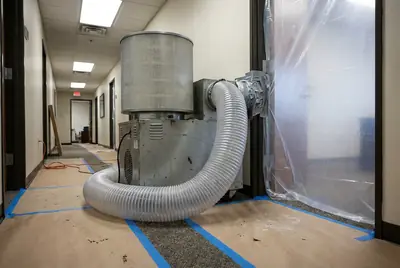
Before anything is loosened, the section under work is isolated and a vacuum collector is coupled to the duct so air moves toward the machine and nowhere else. Floors get covered, ceiling tiles get numbered, and the occupied side of the building keeps working with no idea we are there.
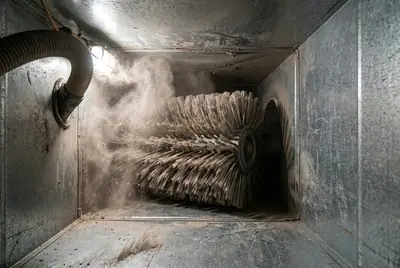
Rotary brushes and compressed air tools work down each run toward the collector, taking the buildup off the metal rather than pushing it deeper. The camera goes back in afterwards. If a stretch still shows residue, it gets done again before the access points are sealed and the registers go back on.
Some buildings need one misbehaving system dealt with. Others need the whole air side reset to zero. The table is the honest version of that choice.
Large sites are phased so no floor loses more than one night, and the same crew lead stays on the job from the first shift to the last photo.
A recorded pass through supply and return trunks, with findings you can watch rather than take on faith.
Rotary brushes and air whips sized to each duct, working the full length of every run toward the collector.
Vacuum units with fine filtration pull everything loosened straight out of the ductwork and off site.
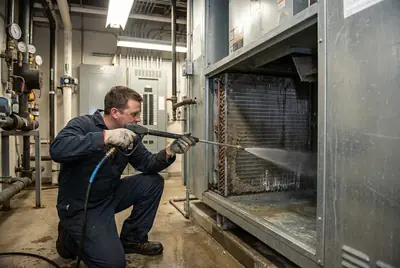
Blower wheels, plenum interiors and coils degreased and rinsed where the air actually picks up its speed.
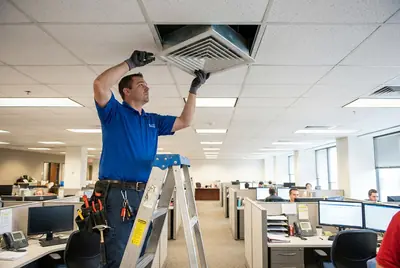
Every visible fitting comes off, gets washed and goes back straight, because occupants judge the job by what they can see.
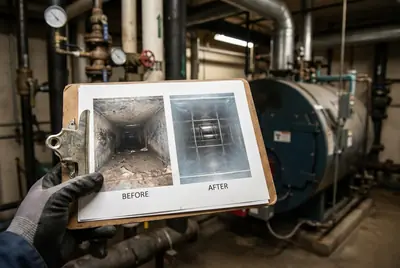
Before and after shots of each run and unit, labeled by floor, sent to whoever answers for the building.
It starts small. Gray fuzz on the desks two days after the janitorial pass. A smell like hot cardboard the first cold morning the heat comes on. A meeting room that feels used up twenty minutes into the hour. The person who sits under the same diffuser and swears the sniffles start on Monday and stop on Friday evening.
None of that proves the ductwork is dirty, and that is precisely why the camera goes in before any quote goes out. But when a building collects complaints of that shape, the supply and return runs are the one place nobody has looked, because nobody can without opening them. Years of drywall sanding, carpet fibers, kitchen aerosols and plain sediment ride the airstream and settle where the air slows down, and every startup of the fans stirs a little of it back over the people below.
After a proper cleaning, the change is undramatic and steady: filters load slower, the startup smell is gone, the dust cycle on the furniture stretches from days to weeks, and the complaints log goes quiet on the subject. Clean air does not announce itself. It just stops reminding people of the alternative.
Our estimator walks the building in Morris with whoever knows it best, counts units and registers, lifts a few access panels and listens to what the occupants have been saying.
One document with the scope floor by floor, the night or weekend windows the work will use, and a figure that does not move once you sign it.
Drop cloths down, furniture sheeted where we pass, the first section isolated and coupled to the collector before a single fitting is opened.
Runs brushed to the collector, units and coils cleaned in place, each zone closed and its registers refitted before the crew moves on.
Access points sealed and labeled, the before and after file sent over, and a short note on anything worth budgeting for the years ahead.
Ceiling height, access hatches and how many years the system went untouched decide where inside these spans a building lands. The walkthrough turns them into one firm figure, and the walkthrough is free.
Containment is not a premium option. The section being cleaned is sealed and kept under suction toward the collector for as long as a tool is inside it, the collectors filter what they capture instead of relocating it, and the debris leaves in closed containers the same night. If a ceiling tile moved, it goes back. If a desk was sheeted, the sheet comes off and the desk looks exactly as its owner left it.
Proof beats promises. The camera footage from the inspection, the before and after photos of every run and the list of access points we cut and sealed all go to you, unedited. And when a run turns out not to need cleaning, the quote says so in writing, because a company that cleans ducts for a living should be the one telling you when yours are fine.
Almost never. The work is phased zone by zone during the hours you hand us, usually nights and weekends around Morris, and each zone is finished, resealed and back in service before occupants return. Most tenants learn the ducts were cleaned from the memo, not from anything they saw.
By never letting it into them. The section under work is isolated and held under suction toward the collector, so loosened debris travels into the machine and not into the room. Floors and furniture along the route are covered anyway, because equipment gets carried through and belt and braces is the right dress code indoors.
With a camera, before any price is written. Buildup on the duct wall is either there or it is not, and you see the footage yourself. When an inspection finds runs that are still serviceable, the quote says so and shrinks accordingly.
Yes, and we would rather not skip them. The unit is where the air picks up speed, moisture and heat, so a spotless duct behind a dirty blower wheel is a job half done. Interiors, wheels, drain pans and coils are cleaned in place as part of a full building scope.
The dining room, the restrooms and the comfort systems are all standard scope. The grease exhaust over the cooking line is a different trade with different tooling, so it is priced separately at the walkthrough once we have seen the hood and the riser, and we tell you plainly if it needs a specialist instead.
A photo file with before and after shots of every run and unit, labeled by floor, plus the inspection footage and a note on the access points we added and sealed. It is the file you show an owner, an insurer or the tenant who asked, without needing us in the room.
Zoom for the lay of the land; the link lists further down name every community we book walkthroughs in from here.
Somewhere above these ceilings there is ductwork nobody has seen in years.
Book the walkthrough