
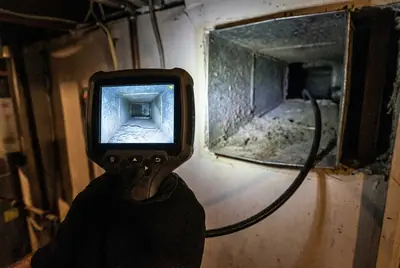
Duct camera inspections
A recorded pass through supply and return trunks, with findings you can watch rather than take on faith.
Offices, storefronts, clinics and classrooms in Ocoee and the rest of Orange County get their ductwork inspected on camera, cleaned overnight and documented with photos.
Free, technical, and it ends in a written price that does not drift.
Do you notice stuffy air inside your local storefront lately? Well, indoor air quality matters a whole lot for your daily hustle. This clever guide shows you how proper ventilation care transforms your workplace.
Now, running a shop in sunny Florida brings unique challenges with humidity. Therefore, keeping your airways pristine prevents nasty mold and gross buildup. This lets you protect your workers and customers from breathing bad junk every single day.
Actually, ignoring those hidden metal pathways inside your walls causes massive headaches down the road. But do not panic because local crews help you fix this mess right away. Which means you dodge expensive utility bills and sudden system breakdowns when you least expect them.
Most business owners completely forget about the giant maze hiding overhead. Yet, dust and debris collect inside those narrow passages constantly. This constant accumulation chokes your climate control units and makes them work way too hard.
Meanwhile, commercial hubs right here in ZIP codes 34761 face relentless moisture levels year round. Because of this dampness, mold spores love to grow inside dark metal ducts. Fortunately, targeted physical scrubbing wipes out those hazards completely before they make anyone sick.
Have you noticed weird smells every time the air conditioner turns on? Well, foul odors usually mean something disgusting rots inside your ventilation channels. This unpleasant reality demands immediate attention from folks who know the trade inside and out.
On top of that, skyrocketing power bills often point straight to restricted airflow. When thick layers of grime block the path, your machinery burns extra juice. Fixing this issue puts money right back in your pocket while keeping rooms cool.
Local businesses in Orange County need reliable partners who understand regional building codes. Because our population hovers around 44,829 friendly residents, local shops stay super busy serving folks. Trusting a nearby crew guarantees fast response times whenever an emergency pops up unexpectedly.
Plus, median household incomes sit nicely around $70,472 in this charming area. This means customers expect clean and polished environments when they walk through your doors. Providing pristine indoor air gives you a massive edge over lazy competitors down the street.
For instance, dirty filters and clogged vents ruin the shopping experience fast. However, routine sanitation sweeps away all traces of neglect in just a few hours. This lets you impress every single visitor with crisp and refreshing indoor breezes.
Trained technicians arrive at your commercial property with heavy duty rotary brushes and powerful vacuums. First, they seal off your vents to trap flying dust inside the pipes. Then, they scrub every single inch of metal until it shines like new.
Next, specialized sanitizing mists neutralize microscopic bacteria hiding in hard to reach corners. This thorough process eliminates allergens that trigger sneezing fits among your hardworking staff. You get total peace of mind knowing your building breathes pure air.
| Service Type | Primary Benefit | Ideal Frequency |
| Commercial Duct Scrubbing | Lowers monthly power bills | Every two years |
| Vent Sanitization | Stops mold growth | Annually |
Leaving your ventilation unmaintained invites poor health and ruined inventory in humid spaces. Alternatively, scheduling routine cleanings saves your pricey cooling equipment from premature burnout. This translates to fewer repairs and much longer equipment lifespans.
Furthermore, happy employees miss fewer shifts due to indoor allergies and sinus issues. Productivity naturally spikes when nobody has to deal with dusty sneezing fits all day. Your bottom line improves drastically simply by clearing out hidden contaminants.
Are you finally ready to ditch that stale office atmosphere for good? Well, taking action takes less than a minute of your busy time today. Just request your complimentary assessment to see exactly what your building requires.
By getting a free quote, you learn about potential airflow problems without spending a single dime. Experienced local contractors evaluate your specific setup and give you honest recommendations right away. This transparent approach ensures you never pay for unnecessary services.
Ultimately, your workspace deserves the absolute best care possible from trusted neighborhood professionals. Do not wait until a complete system failure disrupts your daily operations and loses customers. Reach out right now to secure your free estimate and breathe easier tomorrow.
A camera goes into the trunk lines first. What comes back decides everything: which runs carry real buildup, which only need their registers washed, and which are clean enough to leave alone. The findings are shown to you, not summarized at you, and if the honest answer is that your ducts do not need cleaning yet, that is what the visit concludes.
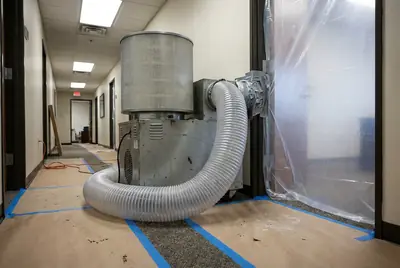
Before anything is loosened, the section under work is isolated and a vacuum collector is coupled to the duct so air moves toward the machine and nowhere else. Floors get covered, ceiling tiles get numbered, and the occupied side of the building keeps working with no idea we are there.
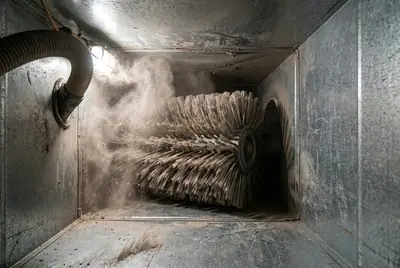
Rotary brushes and compressed air tools work down each run toward the collector, taking the buildup off the metal rather than pushing it deeper. The camera goes back in afterwards. If a stretch still shows residue, it gets done again before the access points are sealed and the registers go back on.
Some buildings need one misbehaving system dealt with. Others need the whole air side reset to zero. The table is the honest version of that choice.
Large sites are phased so no floor loses more than one night, and the same crew lead stays on the job from the first shift to the last photo.
A recorded pass through supply and return trunks, with findings you can watch rather than take on faith.
Rotary brushes and air whips sized to each duct, working the full length of every run toward the collector.
Vacuum units with fine filtration pull everything loosened straight out of the ductwork and off site.
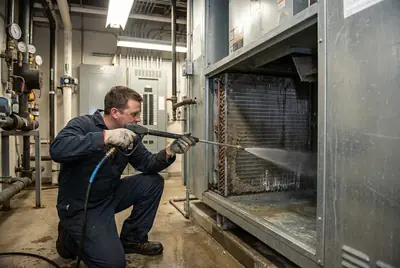
Blower wheels, plenum interiors and coils degreased and rinsed where the air actually picks up its speed.
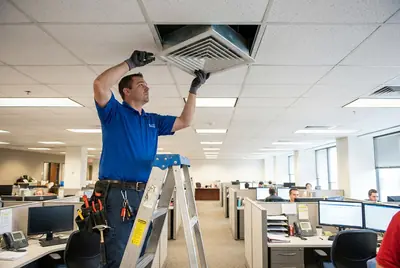
Every visible fitting comes off, gets washed and goes back straight, because occupants judge the job by what they can see.
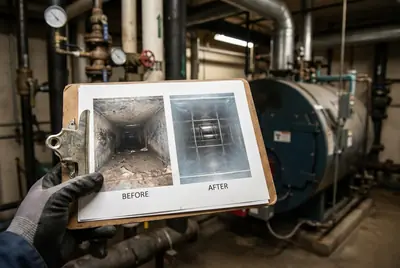
Before and after shots of each run and unit, labeled by floor, sent to whoever answers for the building.
It starts small. Gray fuzz on the desks two days after the janitorial pass. A smell like hot cardboard the first cold morning the heat comes on. A meeting room that feels used up twenty minutes into the hour. The person who sits under the same diffuser and swears the sniffles start on Monday and stop on Friday evening.
None of that proves the ductwork is dirty, and that is precisely why the camera goes in before any quote goes out. But when a building collects complaints of that shape, the supply and return runs are the one place nobody has looked, because nobody can without opening them. Years of drywall sanding, carpet fibers, kitchen aerosols and plain sediment ride the airstream and settle where the air slows down, and every startup of the fans stirs a little of it back over the people below.
After a proper cleaning, the change is undramatic and steady: filters load slower, the startup smell is gone, the dust cycle on the furniture stretches from days to weeks, and the complaints log goes quiet on the subject. Clean air does not announce itself. It just stops reminding people of the alternative.
Our estimator walks the building in Ocoee with whoever knows it best, counts units and registers, lifts a few access panels and listens to what the occupants have been saying.
One document with the scope floor by floor, the night or weekend windows the work will use, and a figure that does not move once you sign it.
Drop cloths down, furniture sheeted where we pass, the first section isolated and coupled to the collector before a single fitting is opened.
Runs brushed to the collector, units and coils cleaned in place, each zone closed and its registers refitted before the crew moves on.
Access points sealed and labeled, the before and after file sent over, and a short note on anything worth budgeting for the years ahead.
Ceiling height, access hatches and how many years the system went untouched decide where inside these spans a building lands. The walkthrough turns them into one firm figure, and the walkthrough is free.
Containment is not a premium option. The section being cleaned is sealed and kept under suction toward the collector for as long as a tool is inside it, the collectors filter what they capture instead of relocating it, and the debris leaves in closed containers the same night. If a ceiling tile moved, it goes back. If a desk was sheeted, the sheet comes off and the desk looks exactly as its owner left it.
Proof beats promises. The camera footage from the inspection, the before and after photos of every run and the list of access points we cut and sealed all go to you, unedited. And when a run turns out not to need cleaning, the quote says so in writing, because a company that cleans ducts for a living should be the one telling you when yours are fine.
Almost never. The work is phased zone by zone during the hours you hand us, usually nights and weekends around Ocoee, and each zone is finished, resealed and back in service before occupants return. Most tenants learn the ducts were cleaned from the memo, not from anything they saw.
By never letting it into them. The section under work is isolated and held under suction toward the collector, so loosened debris travels into the machine and not into the room. Floors and furniture along the route are covered anyway, because equipment gets carried through and belt and braces is the right dress code indoors.
With a camera, before any price is written. Buildup on the duct wall is either there or it is not, and you see the footage yourself. When an inspection finds runs that are still serviceable, the quote says so and shrinks accordingly.
Yes, and we would rather not skip them. The unit is where the air picks up speed, moisture and heat, so a spotless duct behind a dirty blower wheel is a job half done. Interiors, wheels, drain pans and coils are cleaned in place as part of a full building scope.
The dining room, the restrooms and the comfort systems are all standard scope. The grease exhaust over the cooking line is a different trade with different tooling, so it is priced separately at the walkthrough once we have seen the hood and the riser, and we tell you plainly if it needs a specialist instead.
A photo file with before and after shots of every run and unit, labeled by floor, plus the inspection footage and a note on the access points we added and sealed. It is the file you show an owner, an insurer or the tenant who asked, without needing us in the room.
Zoom for the lay of the land; the link lists further down name every community we book walkthroughs in from here.
Somewhere above these ceilings there is ductwork nobody has seen in years.
Book the walkthrough