
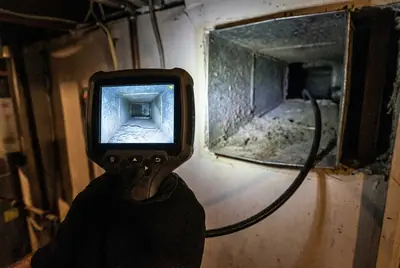
Duct camera inspections
A recorded pass through supply and return trunks, with findings you can watch rather than take on faith.
Offices, storefronts, clinics and classrooms in Plainfield and the rest of Saint Joseph County get their ductwork inspected on camera, cleaned overnight and documented with photos.
Free, technical, and it ends in a written price that does not drift.
Tired of dusty air circulating through your business? You're probably wondering how to tackle that invisible buildup affecting your workspace.
When you think about the air you and your employees breathe all day at your place of work, you might not immediately consider the network of hidden pathways that deliver that air. But that unseen system, the intricate web of channels carrying heated and cooled air throughout your building, can become a significant source of airborne particles. This is where specialized services come into play, addressing the often-overlooked aspect of your commercial property's indoor environment. You want to ensure your workplace isn't just functional but also a healthy and productive space for everyone who walks through the door.
Let's face it, no one enjoys the feeling of stale, stuffy air. It can make focusing difficult and generally create an unpleasant atmosphere. Now, imagine that staleness is amplified by layers of dust, debris, and even microscopic critters that have taken up residence in your building's ventilation system. This accumulation isn't just about aesthetics; it directly impacts the quality of the air you're breathing. Which means that investing in a thorough cleaning of these essential pathways is more than just a maintenance task; it's a strategic move to boost well-being and productivity.
You might be surprised by what lurks within those metal or flexible conduits. Over time, they can trap everything from everyday dust and pet dander to more concerning contaminants like mold spores and bacteria. This buildup can then be recirculated repeatedly, affecting anyone sensitive to allergens or those simply seeking a cleaner working environment. This is why regular attention to this critical component of your building's infrastructure is so important for businesses in and around Plainfield, Indiana.
Think about the typical dust bunnies you see under the sofa. Now, picture that on a much larger scale, clinging to the inside surfaces of your building's air delivery system. Over the years, these channels act like giant vacuum cleaners, drawing in air from your premises and, along with it, all sorts of particles. This collected material can range from simple household dust to more complex substances like construction debris, pollen that infiltrates from outside, and even lint from fabrics.
Furthermore, in environments where certain processes occur, you might find more specialized contaminants. For instance, a workshop might accumulate sawdust, while a restaurant kitchen could have grease particles that solidify over time. These aren't just unsightly; they can break down and become airborne, circulating with every cycle of your heating and cooling. This means the very system designed to keep you at a pleasant temperature might inadvertently be spreading unwanted particles throughout your commercial space.
When these essential pathways get clogged with gunk, it's not just about grossness. Your HVAC system has to work much harder to push air through the obstructions. This extra strain means your equipment uses more energy, leading to higher utility bills, a cost no business owner enjoys. On top of that, overworked machinery is more prone to breakdowns, resulting in costly repairs and potentially disruptive downtime for your operations.
Moreover, the air quality itself takes a nosedive. Stale air can make employees feel sluggish and less focused, directly impacting productivity. For those with allergies or respiratory sensitivities, the constant circulation of dust and potential allergens can lead to increased sick days and a generally less healthy workforce. This creates a domino effect where an overlooked maintenance issue can quietly chip away at your business's bottom line and the well-being of its people.
Considering the intricate nature of these systems and the specialized equipment needed for a thorough cleaning, it's often best to leave this task to the pros. They have the tools and the know-how to get into every nook and cranny, ensuring a truly deep clean. This isn't a DIY job; it requires a level of expertise to do it right.
A professional service provider brings trained technicians who understand the mechanics of different ventilation systems. They use powerful vacuums and specialized brushes designed to dislodge even stubborn buildup without damaging the ductwork itself. Which means you get a more effective and safer cleaning than you could ever achieve on your own.
When you schedule a professional visit for your building's air distribution channels, you can anticipate a detailed process. First, technicians will typically conduct a visual inspection to assess the condition and extent of the contamination. They'll often use specialized cameras to get a clear look inside those hard-to-reach areas, helping them plan the most effective cleaning strategy. This initial assessment is crucial for understanding the scope of the work needed.
Then, they'll set up their equipment. This usually involves powerful industrial-grade vacuums that create significant suction to pull out loosened debris. Alongside the vacuums, they employ rotating brush systems that agitate the interior surfaces of the ducts, breaking free any accumulated dust, dirt, and other contaminants. Which means that by combining powerful suction with mechanical agitation, they can effectively clear out the system.
The actual cleaning involves a systematic approach, working section by section through your building's ventilation network. Technicians will carefully insert specialized tools into the ducts. These tools are designed to reach deep into the channels, dislodging particles that have been stuck for years.
As these particles are loosened, the industrial vacuums immediately capture them, preventing them from becoming airborne within your workspace during the cleaning. This containment is key to a successful and clean operation. Which means you won't be left with a bigger mess than you started with.
A reputable service provider understands the importance of protecting your business's interior. They'll take steps to seal off vents and entry points to prevent dust from escaping into your occupied spaces. They might also use protective coverings on floors and equipment in the immediate work area. This attention to detail ensures that the cleaning process is as contained and non-disruptive as possible.
Investing in a professional cleaning of your commercial ventilation system yields a multitude of advantages that go beyond just cleaner air. You'll likely notice a significant improvement in the overall atmosphere of your workplace. This can lead to a more pleasant environment for both employees and clients.
One of the most immediate and appreciated benefits is the improved air quality. With fewer particles circulating, people who suffer from allergies or respiratory issues often experience relief. This can translate to fewer missed workdays and a healthier, happier team.
When your air pathways are clear, your heating and cooling systems can operate much more efficiently. They don't have to fight against resistance, meaning they use less energy to achieve the desired temperature. This reduction in workload not only saves you money on utility bills but also puts less stress on the equipment.
This decreased strain can significantly extend the lifespan of your HVAC units. Regular cleaning acts as preventative maintenance, helping to avert premature wear and tear. Which means you'll likely face fewer costly repairs and replacements down the line, saving your business valuable resources.
Beyond the functional aspects, a clean ventilation system simply makes your business smell better. Odors that tend to get trapped and recirculated are eliminated. This creates a more inviting and professional atmosphere for everyone who enters your establishment. Imagine walking into a space that smells consistently fresh and clean, regardless of the activities within.
Businesses in any sector can benefit from this specialized cleaning, but certain types of establishments in the Saint Joseph County area might see even greater advantages. For instance, healthcare facilities, schools, and daycares, where indoor air quality is paramount, should consider this a regular part of their maintenance schedule. These environments have a heightened responsibility to protect the health of their occupants.
Office buildings, especially those with open-plan layouts or a large number of employees, can significantly improve employee morale and productivity with cleaner air. Even retail spaces can create a more appealing shopping experience for customers when the air is fresh and free of stale odors or dust. Basically, any commercial entity that values the well-being of its people and the efficiency of its operations in the 46168 ZIP code and surrounding areas should be thinking about this service.
If you operate a restaurant or food service establishment in Plainfield, grease buildup in your ventilation system can be a serious fire hazard and an unpleasant source of odors. Professional cleaning addresses these specific risks, ensuring a safer and more appealing dining environment. This is especially critical in a community like this with its many popular eateries.
Similarly, businesses in manufacturing or workshops that generate dust or particulate matter will find immense value in regularly clearing their air channels. This not only improves air quality but can also help maintain a cleaner overall workspace, reducing the need for frequent surface cleaning. It's all about creating a more conducive environment for your specific business needs.
You've likely seen the effects of poor air circulation firsthand, that feeling of a stuffy room or the telltale signs of dust settling faster than it should. Addressing the source of this problem within your commercial ventilation system is a proactive step that pays dividends. It's about creating a healthier, more efficient, and ultimately more productive environment for your business.
Investing in this service means you're not just cleaning ducts; you're investing in the well-being of your employees, the longevity of your HVAC equipment, and the overall impression your business makes. It's a comprehensive solution to a widespread issue. Which allows you to focus on what you do best, knowing the air you're breathing is as clean as it can be.
While there is a cost associated with professional cleaning, it's crucial to view it as an investment rather than an expense. The savings on energy bills, reduced HVAC repair costs, and potential decrease in employee sick days can far outweigh the initial outlay. Think of it as a long-term strategy for operational efficiency and employee well-being.
Especially for businesses in areas like this, with a median household income around $62,828, understanding the value proposition is key. You're not just paying for a service; you're paying for a tangible improvement in your business's environment and its operational costs. This makes the decision a financially sound one.
If you're ready to experience the benefits of cleaner air and a more efficient HVAC system, the next step is simple. Many local providers offer free, no-obligation estimates for their services. This allows you to understand exactly what's involved and the associated costs without any initial commitment.
They can assess your specific needs and provide a detailed plan tailored to your building. This personalized approach ensures you get the most effective service for your unique situation. Which means you can make an informed decision about improving your business's indoor air quality.
Opting for a local provider in the Plainfield, Indiana, area brings its own set of advantages. These professionals understand the specific environmental factors that might affect your building's ventilation, such as local climate patterns or common building materials used in the region. They are familiar with the community and are invested in serving their neighbors.
Their proximity means they can often respond more quickly to your needs, which is crucial if you're experiencing an urgent issue or simply want to schedule service efficiently. Building a relationship with a local company often translates to more personalized service and a greater understanding of your business's unique requirements. It's about having a trusted partner right in your backyard.
Plainfield, located in Saint Joseph County, is a vibrant community with a growing number of businesses. Understanding the specific needs of businesses operating within this local economy is something a local contractor excels at. They're not just performing a service; they're contributing to the health and success of their own community.
This local knowledge allows them to offer more tailored advice and solutions, recognizing that what works for one business might not be the best fit for another. Their understanding of the local infrastructure, from residential areas to commercial hubs across ZIP codes like 46168, gives them an edge.
Choosing a local expert means you're likely dealing with a team that values its reputation within the community. They understand that repeat business and positive word-of-mouth are essential for their success. This often translates into a higher level of accountability and a commitment to customer satisfaction.
You can often find reviews and testimonials from other local businesses, giving you confidence in their abilities. Which means you're more likely to receive dependable service from professionals who are genuinely invested in the well-being of your business and the broader Plainfield area.
Don't let dust and debris compromise the air quality and efficiency of your commercial property any longer. Addressing the cleanliness of your ventilation system is a crucial step towards creating a better workplace. It's a straightforward way to make a significant positive impact.
You have the power to transform your business's environment, making it a more pleasant and productive place for everyone. This is about more than just a cleaning service; it's about enhancing your business's overall operation and the experience of everyone who walks through your doors.
The first step is as simple as reaching out for a free, no-obligation estimate. This allows you to get a clear picture of what's needed and how a professional cleaning can benefit your specific business. Don't hesitate to ask questions and get all the information you need to make an informed decision.
Imagine the difference cleaner air can make. It's a tangible benefit you and your team will appreciate every single day. Which means that taking this step is an investment in your business's future.
Experiencing the benefits of a professionally cleaned commercial duct system is within your reach. Let the local pros handle the hard work, so you can enjoy the results. It's time to ensure your business is operating at its best, with the cleanest air possible.
A camera goes into the trunk lines first. What comes back decides everything: which runs carry real buildup, which only need their registers washed, and which are clean enough to leave alone. The findings are shown to you, not summarized at you, and if the honest answer is that your ducts do not need cleaning yet, that is what the visit concludes.
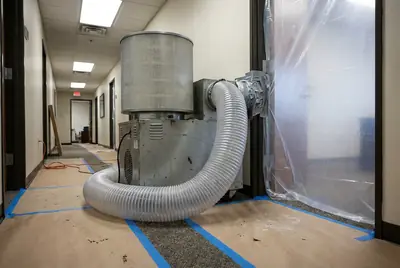
Before anything is loosened, the section under work is isolated and a vacuum collector is coupled to the duct so air moves toward the machine and nowhere else. Floors get covered, ceiling tiles get numbered, and the occupied side of the building keeps working with no idea we are there.
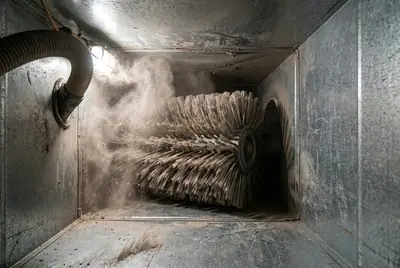
Rotary brushes and compressed air tools work down each run toward the collector, taking the buildup off the metal rather than pushing it deeper. The camera goes back in afterwards. If a stretch still shows residue, it gets done again before the access points are sealed and the registers go back on.
Some buildings need one misbehaving system dealt with. Others need the whole air side reset to zero. The table is the honest version of that choice.
Large sites are phased so no floor loses more than one night, and the same crew lead stays on the job from the first shift to the last photo.
A recorded pass through supply and return trunks, with findings you can watch rather than take on faith.
Rotary brushes and air whips sized to each duct, working the full length of every run toward the collector.
Vacuum units with fine filtration pull everything loosened straight out of the ductwork and off site.
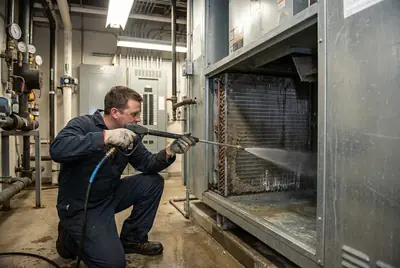
Blower wheels, plenum interiors and coils degreased and rinsed where the air actually picks up its speed.
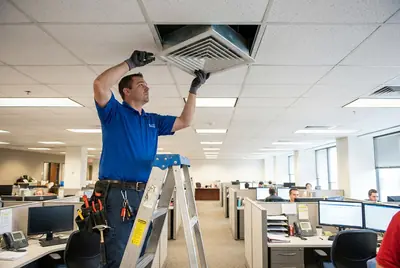
Every visible fitting comes off, gets washed and goes back straight, because occupants judge the job by what they can see.
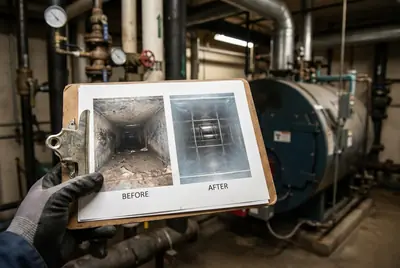
Before and after shots of each run and unit, labeled by floor, sent to whoever answers for the building.
It starts small. Gray fuzz on the desks two days after the janitorial pass. A smell like hot cardboard the first cold morning the heat comes on. A meeting room that feels used up twenty minutes into the hour. The person who sits under the same diffuser and swears the sniffles start on Monday and stop on Friday evening.
None of that proves the ductwork is dirty, and that is precisely why the camera goes in before any quote goes out. But when a building collects complaints of that shape, the supply and return runs are the one place nobody has looked, because nobody can without opening them. Years of drywall sanding, carpet fibers, kitchen aerosols and plain sediment ride the airstream and settle where the air slows down, and every startup of the fans stirs a little of it back over the people below.
After a proper cleaning, the change is undramatic and steady: filters load slower, the startup smell is gone, the dust cycle on the furniture stretches from days to weeks, and the complaints log goes quiet on the subject. Clean air does not announce itself. It just stops reminding people of the alternative.
Our estimator walks the building in Plainfield with whoever knows it best, counts units and registers, lifts a few access panels and listens to what the occupants have been saying.
One document with the scope floor by floor, the night or weekend windows the work will use, and a figure that does not move once you sign it.
Drop cloths down, furniture sheeted where we pass, the first section isolated and coupled to the collector before a single fitting is opened.
Runs brushed to the collector, units and coils cleaned in place, each zone closed and its registers refitted before the crew moves on.
Access points sealed and labeled, the before and after file sent over, and a short note on anything worth budgeting for the years ahead.
Ceiling height, access hatches and how many years the system went untouched decide where inside these spans a building lands. The walkthrough turns them into one firm figure, and the walkthrough is free.
Containment is not a premium option. The section being cleaned is sealed and kept under suction toward the collector for as long as a tool is inside it, the collectors filter what they capture instead of relocating it, and the debris leaves in closed containers the same night. If a ceiling tile moved, it goes back. If a desk was sheeted, the sheet comes off and the desk looks exactly as its owner left it.
Proof beats promises. The camera footage from the inspection, the before and after photos of every run and the list of access points we cut and sealed all go to you, unedited. And when a run turns out not to need cleaning, the quote says so in writing, because a company that cleans ducts for a living should be the one telling you when yours are fine.
Almost never. The work is phased zone by zone during the hours you hand us, usually nights and weekends around Plainfield, and each zone is finished, resealed and back in service before occupants return. Most tenants learn the ducts were cleaned from the memo, not from anything they saw.
By never letting it into them. The section under work is isolated and held under suction toward the collector, so loosened debris travels into the machine and not into the room. Floors and furniture along the route are covered anyway, because equipment gets carried through and belt and braces is the right dress code indoors.
With a camera, before any price is written. Buildup on the duct wall is either there or it is not, and you see the footage yourself. When an inspection finds runs that are still serviceable, the quote says so and shrinks accordingly.
Yes, and we would rather not skip them. The unit is where the air picks up speed, moisture and heat, so a spotless duct behind a dirty blower wheel is a job half done. Interiors, wheels, drain pans and coils are cleaned in place as part of a full building scope.
The dining room, the restrooms and the comfort systems are all standard scope. The grease exhaust over the cooking line is a different trade with different tooling, so it is priced separately at the walkthrough once we have seen the hood and the riser, and we tell you plainly if it needs a specialist instead.
A photo file with before and after shots of every run and unit, labeled by floor, plus the inspection footage and a note on the access points we added and sealed. It is the file you show an owner, an insurer or the tenant who asked, without needing us in the room.
Zoom for the lay of the land; the link lists further down name every community we book walkthroughs in from here.
Somewhere above these ceilings there is ductwork nobody has seen in years.
Book the walkthrough